The Inner Game Methodology: Unlocking Natural Performance at Work
Today's knowledge work amplifies interference—constant notifications, performance metrics, remote isolation, and "always-on" culture. The result? Burnout, procrastination, disengagement, The Inner Game has been a liberating resource for decades.
The Inner Game® began with a deceptively simple observation: sometimes what gets in the way of performance isn't a lack of ability. It's the interference we bring to the experience.
W. Timothy Gallwey first developed the Inner Game through his work in tennis in the early 1970s. His 1974 book The Inner Game of Tennis challenged conventional ideas about instruction and performance. The principles were later applied far beyond sports, including to work, leadership, learning and organizational life.
The distinction Gallwey made was between two games being played at the same time.
- The outer game involves the external objective: the opponent, task, goal, deadline, problem or result.
- The inner game involves what happens within us as we pursue that objective: our attention, judgments, doubts, fears, assumptions and attempts to control what happens.
We spend a great deal of time working on the outer game. We develop skills, set goals, create plans, measure results and try to improve execution. All of that can matter. The Inner Game asks us to pay attention to something else as well: what might be interfering with our ability to use the capability we already have?
Performance, Potential and Interference
One of the best-known ideas associated with the Inner Game is expressed in a simple relationship:
Performance = Potential − Interference
Potential represents the capability available to us. Interference is what can get in the way of expressing that potential: self-doubt, fear of failure, judgmental thinking, distraction, tension or confusion about what we're trying to accomplish.
This changes the performance question. Instead of always asking, What more do I need to add?, we can also ask, What might be getting in the way?
That distinction matters because our instinct when performance becomes difficult is often to add more effort, more instruction or more control. Sometimes those responses are useful. But sometimes they add to the very interference that is already present.
Self 1 and Self 2
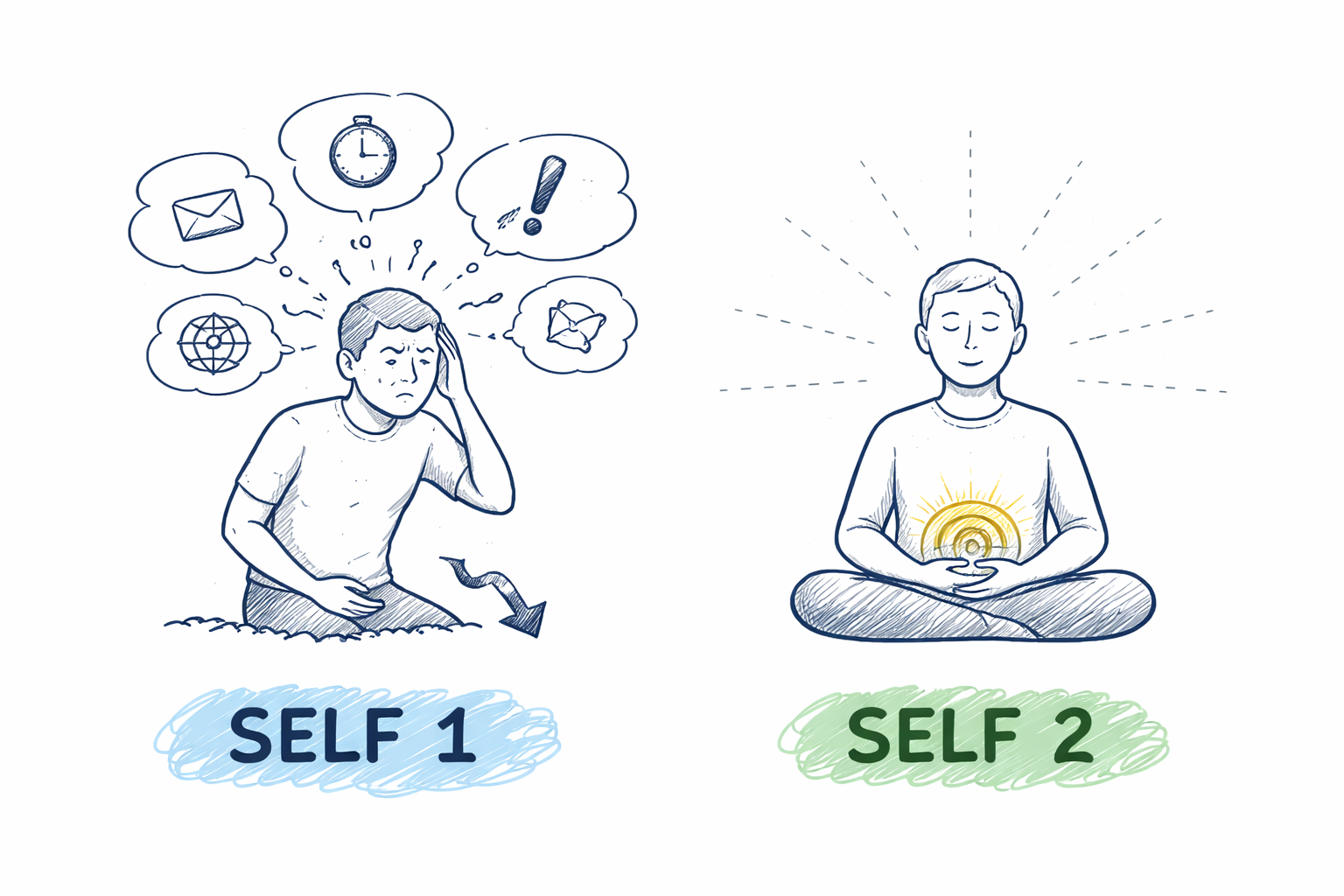
Gallwey used the language of Self 1 and Self 2 to help make this internal experience visible.
Self 1 is the part of our internal dialogue that tells, judges and attempts to control. It is the voice that says, Don't make that mistake again. You should be better at this. Hurry up. Don't fail. You're doing this wrong.
Self 2 is the part of us capable of doing and learning through experience without requiring that constant stream of instruction and judgment. We see evidence of it whenever a capability becomes natural enough that consciously controlling every movement or thought would actually make performance more difficult.
The point isn't that Self 1 is bad and Self 2 is good. Nor is the objective to somehow eliminate thought. The useful question is whether our internal dialogue is helping us engage with what is happening or interfering with our ability to do so.
Attention Changes the Experience
This is why attention plays such an important role in the Inner Game.
When attention becomes consumed by judgment, fear, instructions or imagined outcomes, it becomes harder to notice what is actually happening. The Inner Game develops the capacity to direct attention toward relevant and observable aspects of the experience.
Gallwey's work with Critical Variables is an example. Rather than trying to consciously control an entire performance, we can identify variables that are important to the objective and direct relaxed attention toward them.
That may sound simple. In practice, noticing where our attention goes—and where it might be more useful—is an important part of learning from experience.
From Tennis to Work
The tennis court provided Gallwey with a particularly visible laboratory for these ideas, but the Inner Game was never limited to sports.
Consider a difficult conversation at work. There is an outer game: the issue being discussed, the people involved and the outcome that needs to be reached.
But there may also be an inner game. Perhaps you're rehearsing what you're going to say instead of listening. Perhaps you're worried about how the other person sees you. Perhaps you've already decided how they're going to respond. Perhaps you're judging your own performance while the conversation is still happening.
The same thing can happen when giving a presentation, learning a new skill, leading a team, dealing with change or trying to solve an unfamiliar problem. There is what is happening—and there is everything we may be adding to what is happening.
Even decision-making has an inner game. Information and alternatives matter, but so can the judgments, assumptions, fears and doubts we bring to the process. Becoming aware of that interference doesn't tell us which decision to make. It may, however, help us see more clearly what we're bringing to the decision.
Performance Is Only Part of the Picture
The application of the Inner Game to work also introduces a broader way of thinking about the experience of working: Performance, Learning and Enjoyment.
Performance matters. Work has outcomes, responsibilities and expectations. But focusing exclusively on results can cause us to overlook two other things happening while the work is being done.
We are also learning—or failing to learn—from experience. And we are having an experience of the work itself.
The Inner Game at Work brings these three dimensions together:
- Performance — the results being produced.
- Learning — what is being discovered and developed through experience.
- Enjoyment — the quality of the experience while the work is being done.
The relationship matters because work doesn't stop while we learn, and learning doesn't have to be separated from performance. Much of our capability is developed while doing the work itself.
A Different Starting Point
There is a tendency when something isn't working to immediately ask what needs to change.
The Inner Game suggests another starting point: notice what is happening.
Where is your attention? What are you observing? What are you assuming? Where is judgment entering the experience? What are you trying to control? What might be interfering with the capability already available to you?
Those questions don't necessarily produce an immediate answer. That isn't their purpose. They create an opportunity to see the situation differently before deciding what, if anything, needs to change.
That idea has had a significant influence on Work Reframe. The Work Frame™ looks at work through Performance, Learning and Enjoyment because performance alone doesn't tell us enough about our experience of work.
Sometimes improvement requires developing a new capability. Sometimes circumstances genuinely need to change. And sometimes it is worth first asking whether something is getting in the way of what is already there.
Experience the Inner Game® Methodology
The official Inner Game® Methodology Workshop provides an experiential introduction to the methodology developed from the work of W. Timothy Gallwey. Participants explore Self 1 and Self 2, Focus and Critical Variables, Performance, Learning and Enjoyment, performance and interference, and the application of the methodology to work and life.
The workshop is delivered by Antony D'Avino, Certified Inner Game® Methodology Facilitator.